Yesterday I visited a meeting on the future of crossmedia by Anmi Summerschool in Amsterdam. Michiel Buitelaar, KPN and Edwin Tromp, Talpa cross media where giving their views on future developments. Unfortunately I missed the first part of Edwin's presentation, but got right on time to learn where Talpa is expecting to make money: traditional spot, sponsored content, stream spots, subscription fee, pay-per-view, shared business and market places. He has also talked about putting the concept central at Talpa and then thinking channels (I got this second hand). I think it is the right idea, but with the 'wrong' people, because Talpa's team is dominated by television people. They are not able to think crossmedia, as is becoming ever more clearly visible by now. Not an easy job for Tromp I think. Then Buitelaar, KPN talked freely of his ideas on the future. I happen to know Michiel from many years ago, where he was only thinking telecom. And was very eager to learn about the other media I was coming from at the time (television and internet) He has made a further step in his thinking from then and had a very clear presentation. Unfortunately he also turned out to have become quite blase as director of the KPN consumer division, I noticed when I walked up to him. Not all legs can carry the weight elegantly. Michiel talked about co-creation in the form of a 'pigeon channel'; A channel where one pigeonkeeper can upload his films of the pigeons he is keeping and where other pigeonlovers can watch the birds as they fly away. Not your everyday mass television offering, but it will be there eventually, a particular niche producing and viewing each others' content. He is definitely right that it will be going this way. It already is. KPN wanted to ENABLE this, which I think is a smart position to take. But how?
Thursday, August 25, 2005


Monday, August 22, 2005
Let's work with kids!
I wondered what sonja kangas was doing in Finland, so I decided to ask. This is one of the interesting projects she is involved in. It's about crossmedia for kids and it is this week. So you have to hurry to attend the workshop! (I am afraid I will not be able to be there, but comments on the workshop of attendees are very welcome! )
http://www.studio12-21.se/crossmedia/
Friday, August 19, 2005
After the first week..Talpa
If I am kicking at forehand at Talpa (de Mol not spending..) let me also make up the balance after Talpa on air in the Netherlands for one week. First of all, an amazing prestige to have it running so well in the first week. This marks the truly professional television people working at Talpa (as I have said before). As it is I have some experience with starting up a new channel (about ten years ago I was part of it all at SBS) and so I know how difficult this is. Another compliment goes to Beau van Erven Dorens and all of his team working at NSE. They truly have amazed me! NSE has a huge potential and already has a good ritm and beat to it. Definitely very much NOW. But..then "Thuis" the programme preceding NSE really isn't NOW anymore. It feels terribly outdated. And off course it is not about crossmedia at all (which it is pretending to be...). If they think putting somebody with a laptop in the public to read aloud the e-mails during the show is crossmedia..Oh dear. 'Thuis' is an excellent example of NOT understanding what crossmedia is about. Forcing other channels in the programme in such an unnatural way. It makes me sad, it really does to see this happening!
Monday, August 15, 2005
Italian crossmedia modelling: proiettiliperscrittori
This is very interesting. An italian scolar that is trying to model crossmedia. His latest notions are of a supportive/proactive model and competitive/defense model (don't know exactly what he means and planning to ask him later today) Another notion is to use the latest theories on the shaper of the universe. Don't really get it yet, but it is definitely triggering insights. Take a look.
proiettiliperscrittori
Crossmediaforum
If you would like, you can discuss crossmedia subjects on this forum. It can be an interesting means, a forum and it is definitely very democratic, but I think it gets messy very easily.
Anyway, it is a good initiative, see what you can find of your liking here (It is in Dutch only by the way).
Crossmediaforum
Friday, August 05, 2005
Wednesday, August 03, 2005
Narrowcasting in NL: hip tv: The Entertainment Group
All Talpa has to do, is buy this later, which will definitely happen,
if you look at the artists and the board, from the Entertainment Group one of
the initiators of this project: both familiar liaisons of De Mol.
(how to keep your friends rich)
And it will all be more crossmedia after all.
Looks really nice.
http://www.hiptv.nl
The Entertainment Group
John de Mol; All that money and nothing to spend..
John de Mol promissed to build the ideal convergence model in the Netherlands...Sounds exciting.. doesn't it. I thought so too, but how ignorant. He is entering the market with a more then traditional channel, all of it dominated by traditional television programmes. Working only with well established companies, you know.. safety first. Bringing really nothing new actually. From a business perspective, I can understand the strategy of entering a competitive market and you are not going to do it all different on top of that. It would be asking for trouble. That's healthy economic thinking. But Talpa is boringly old fashioned television thinking. This is not about me, not selling a project, I have not even offered anything to Talpa yet (and do not see any fit for my crossmedia setups in the schedule as it is right now, besides I need the advertisers before all that). But there have been lots of little companies trying to do new things. If you tell the market you are (going to be) about crossmedia, well show (at least one thing). All that money and nothing to spend.
Monday, August 01, 2005
United Productions.co.uk: Exploiting the Future
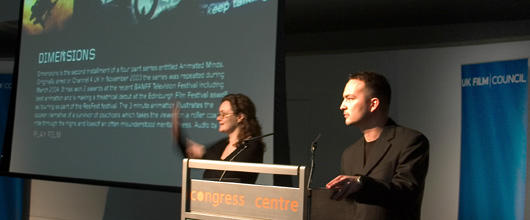
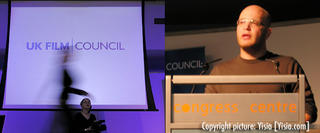 The UK’s Film Council recent event, Exploiting the Future - Digital Opportunities for diversity and difference was not just timely but illustrative of the digital ghost in the machine peering into tomorrow. The PD150 a must-have in any digital film making armoury is about to be toppled by High Definition Cam-corders costing about the same. Films with interstitial multiple arcs (think hypertext) in which cinema-goers can influence the film's narrative with SMS/ MMS is an interesting development. It could mean a studio and directors cut run simultaneously with the audience choosing what's on screen. United Productions.co.uk: Exploiting the Future http://www.ukfilmcouncil.org.uk/
Friday, July 29, 2005
Sites honored for interactive storytelling, rethinking journalism - CyberJournalist.net - Sites honored for interactive storytelling, rethinking journalism
Five finalists have been named for the 2005 Batten Awards for Innovations in Journalism, which gives cash prizes up to $10,000 for "setting new standards for interactive journalism, advancing creativity in digital storytelling and recalibrating the role that news organizations play in their communities." Take a look..
Sites honored for interactive storytelling, rethinking journalism - CyberJournalist.net - Sites honored for interactive storytelling, rethinking journalism
Tuesday, July 19, 2005
Mobile marketing by SMS DEBAT Partner Jigal Schrijver
Often Jigal and I agree on how to approach things (not always ;-). We work together on SMS DEBAT. He wrote this inspiring article on mobile marketing. IN which I like the crossmedia thinking he displays. Take a look ...
LaComunidad Nieuwsbrief | 2e jaargang | 4e editie | � 2005 LaComunidad
Tuesday, July 12, 2005
A Storied Career:
Another jewel found by Christy Dena's work. Christy has landed in a turmoil by now (see http://www.crossmediastorytelling.com) which means the academic world is beginning to see the light. Now let's hope there's commerce coming after this.
A Storied Career: Storytelling for College Students: Stealth or No Stealth?
CBBC multichannel strategy for children

Alison Sharman, the recently installed controller of CBBC, sees CBBC as the "vanguard" of the digital revolution:"The phenomenal success of the iPod demonstrates to me some important general themes about the way media consumption is evolving.
It is going personal, mobile and, most important, on-demand," she said. Sharman added that we are in an age where viewers increasingly take what they want, when they want it.
"And this genuinely revolutionary change in the consumption of content means that we must take a long, hard look at how we currently go about providing that content; how we schedule; and how we distribute it. It is not enough just to upgrade what we currently do, we need a whole new operating system, a new way of thinking about and executing content creation and delivery. We need - in many ways - to redefine what we mean by broadcasting," she said.
C21Media:
Monday, July 11, 2005
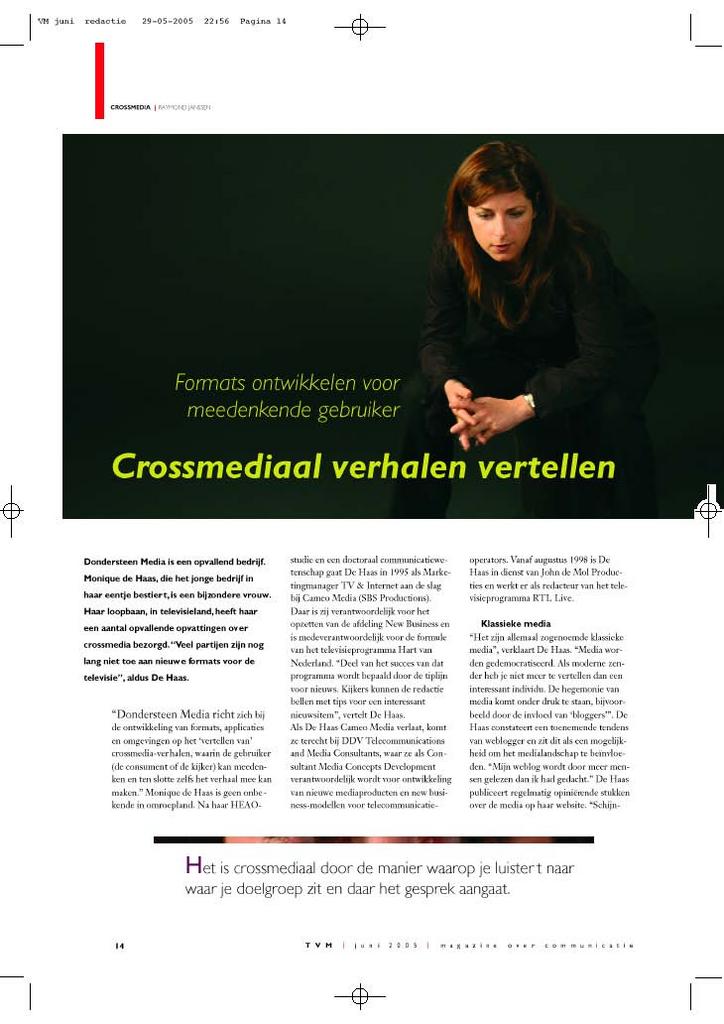
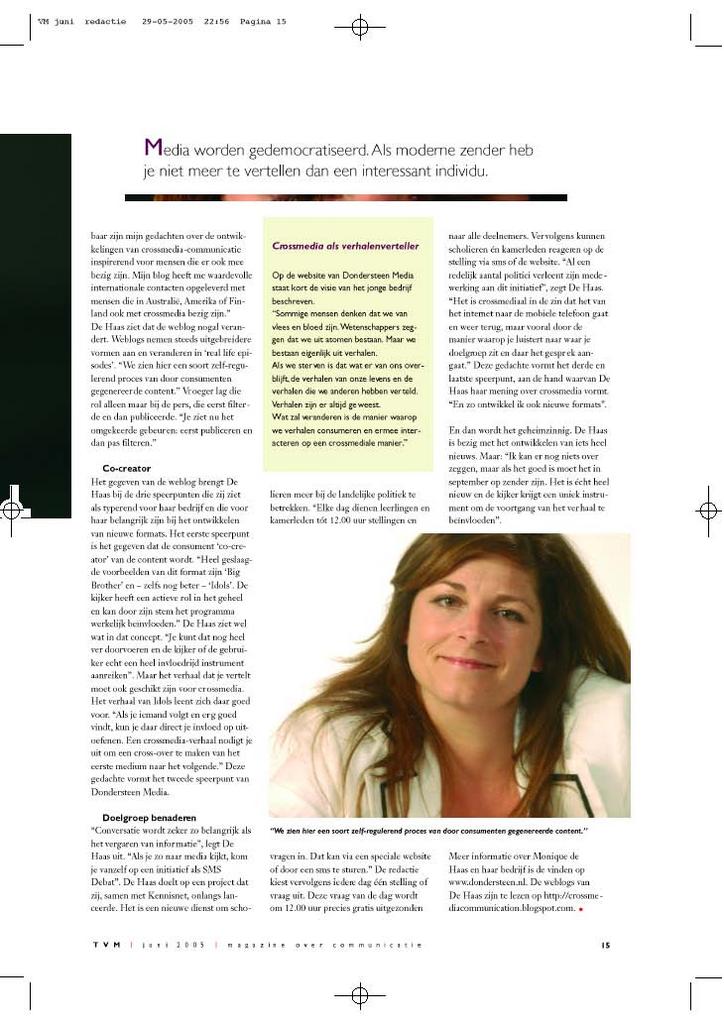

Monday, July 04, 2005
NPS "leaving" may also open doors to new crossmedia initiatives..
After first being startled by the decision of Van der Laan to ban the NPS from a budget I have to reconsider. At first I feared real investigative journalism to disappear. But that need not be true, because when this may disappear there will inevitably be people picking up the glove. As I propagated myself so many times, we are moving toward an environment where people will be in greater control over the information they want to consume. They will be more active in looking for that even up to really (co-)creating content. The best investigative journalism already these days, originates from the amateur reporters on blogs, just happening to be right on top of the subject. So drawing that line a little further, say three years from now when the plans of Van der Laan are to be effective, the landscape will probably have changed so much already that the minor voice will have found there new homes in the niche channels by then.
Friday, July 01, 2005
swarming

Talking about community and conversations I looked at swarming again and realised now that this application is working at the stage just before that, community and contact. In the right context the swarming application may be very effective. Take a look at www.eyebees.com
Tuesday, June 28, 2005
Dutch mediamarket: Talpa coming, NPS leaving the stage? And KPN has 1 mld EU to spent on Telfort?

Yesterday was quite a day for the Dutch Broadcast market. While Talpa where presenting their new channel in a glossy entourage on one side of the mediapark in Studio 21 (see de Mol's ideas on crossmedia on http://www.talpa.tv.. PS. I like the story, but I didn't not see it in the programming yet) ... on the other side of the mediapark in Hilversum, Medy van der Laan situated in a packed basic room was in fierce discussion with employees of the NPS, the public broadcast channel that is put out of play by this state secretary of media. An odd choice to say the least, because she wants public broadcasting to be more about opinion and debate and less about amusemen and it is just the NPS that is taking care of the minor voice in the public debate. I have agreed with van der Laan on the necesarry changes for Public Broadcasting, where a lot of money is going to the management of the broadcasters and NOT to programmemakers. But I do not understand the choice to ban the NPS, which offers typical content for the public domain. It is just this minority voice that needs be protected.
KPN, in huge debts because of the high paid UMTS rights, still had 1 miljard Euro hidden somewhere to buy Telfort. I do not understand money flows in telecommunications! I really do not!
Monday, June 06, 2005
Community as building blocks for communication
Ah live as a communication manager isn't what it used to be, hey! Neatly dividing your target groups in the 20-49 yrs groups does not seem to work effectively anymore. New channels like the internet and telephone are interfering in the picture and what to do with them? And what about these new means like digital channels or iptv? Can I reach my audience through these means? How to target then? Will they still see/hear/notice me?
There are two important keywords to remember:
1. community
2. conversations
It is all going to be about having conversations with the right community to build:
a. interest
b. believability
c. trust
And finally ..connect with your target group. Ever wondered, which communities you are part of? If your really think about that I am sure you will conclude that through the use of the internet you have become part of many more communities then before. All little villages in the global network society. Besides the family, regional and working community that you are already a part of before. These new participations in communities will have probably come naturally to you. Logical because there where mutual interests being served by joining the community so obviously you joined! And you decide how much time and effort to invest in them. This all depends on relevance, timeliness and functionality of the communities to you. People are all members of a mass and many niche communities. The art is to use this knowledge to your advantage and let the communities work with you. Listen, look and see what is happening with your customers. Instead of dictate, tell and sell to them.
Friday, June 03, 2005
Crossmedia is the buzz, but where is the money?
The buzz is about crossmedia and that should be good news, right? But, what do I hear.. advertisers are looking hard for new ways to communicate with target groups that change media consumption behaviour dramatically. But they don't know where to turn!
Well, not to your usual advertising agency, that's for sure.
Not to your broadcaster to arrange for a sponsored programme. They just want you to pay for your spots and let them do the buying of cheap re-runs in a package deal. That is their business model (for just a very little while more)
Not to a big producer to ask for a programme. Because they only know how television works and haven't got a clue about your business or marketing communication issues.
Advertisers know because they have tried this again and again. And now they don't know anymore, because there is no "well-established" company to help them solve this problem. You need to see that you cannot find new ideas with people dependable of you paying them for their old ideas. I am not going to eat my own shoe, right! First, you are not going to find an established company in this field, because it is pioneers' ground. And secondly it is huge impact pioneering ground. Simply because the public is ready for it, now all you have to do is get up to their speed. So, you need to get out there and look for the pretty little jewels laying around
(by the way I do consider my company to be one of those precious gems)
Just do it and you will find it is going to work out just really wonderfull!
Wednesday, June 01, 2005
Communities Dominate Brands
Found this through an article in Emerce on "open source marketing". An interesting article which also mentions co-creation. The journalist however takes a more technical approach to the subject, and sees co-creation as a product of opensource software. Unfortunately, thereby they take it out of the very important cultural context. Why do people WANT to co-create should be the first step at looking at the subject and that is NOT a technical question at all. People are NOT motivated by technique. On this blog you may find some very well informed articles and comments on the movement of communities (co-creation and crossmedia .. related in my opinion)
Communities Dominate Brands
Tuesday, May 31, 2005
BBC Training & Development > Free Online Broadcast & New Media Courses
Found this through the website of Christy Dena, my australian crossmedia colleague (she is in my favorite links: crossmediastorytelling). It is really nice of the BBC to teach us how to make television, since a lot more of us are going to do this in the near future when co-creating crossmedia stories! I was in Brussels (again) at the EC last monday. The IST directive is going to include a lot more media then before, because of the reality of convergence taking place. Focus will be more individual centric policies instead of industry centric policies. The goal is to empower the EU individual. For tommorow polls are that the Dutch will vote against the EU constitution. Still the politicians that I have spoken (for SMS DEBAT), in favour or against the EU constitution, are happy anyway because the subject of the EU is evidently beginning to be important to the people and that is perceived as a gain come what may..
BBC Training & Development > Free Online Broadcast & New Media Courses
Sunday, May 29, 2005
NEW dutch station TEN goes for (golden) OLDies
The profile of TIEN (ten) the new Dutch television station that John de Mol is launching the next season in the Netherlands is slowly becoming clear. What strikes most is the use of old (proven) Endemol formats like Big Brother, The Soundmix Show and Deal or No Deal and not Endemol but with a long history Robinson Island. With the announcement of his enterprise in september 2004 de Mol was generating publicity with his idea of giving the Netherlands a real convergence model not seen before... Well- off course we must wait and see.. but I don't see it yet. I see what I have seen so many times before. A focus on old-thinking television with some quick and dirty add-ons like SMS-TV and talks about programms at the Talpa owned radiostation 538 and sister station Noordzee FM. Sure it will work, but it could have been so much prettier. How can you start up a media "imperium" now and take it from a yesterday starting point?
Wednesday, May 25, 2005
New formats for news
Here is an excellent report from the mediacenter about the future of newsmedia. I really could not agree more then with their description of the changes. Which are upon is in Europe just as well. But the pace is slacking in EU. Why isn't there a mediacenter like institute for the even more diverse European media market? News is of serious influence on how people perceive the world and make decisions in line with that. It is of imminent social cultural importance.
http://www.mediacenter.org/mediacenter/synapse/synapse_psp_0405.pdf
Monday, May 23, 2005
Blogs and the news: BuzzMachine... by Jeff Jarvis
Here is a valuable tip for journalists that are up to speed with the changing news media landscape: Here's what they do in the states with the influence of bloggers. So the basic idea is, be smart and look at it fresh and get those voices in your format!
BuzzMachine... by Jeff Jarvis: "CNN has the chicks reading the geeks. MSNBC started by having bloggers actually on the air and I thought that was good (being one of them). Last week, they switched format, it seems, to have producer and nice guy Tony Maciulis do the reports: He's good at it. Everybody's reading text off a screen and, yes, it does make for a straight line.
So what's the point? Well, sure, TV wants to get the geek-cool ruboff of this blog thing. But I think it's good that they're also promoting these new voices: The more the better. Have they found the right way to do it? Not yet.
MSNBC has talked about having a blog reporter and then having bloggers on to have actual opinions. I think may end up being a good way to go.
This week, MSNBC's Connected had me on not do the blog report -- I'll miss that question: 'What's happening in the blogosphere, BlogDaddy?' -- but instead to have actual opinions about the news media and the internet.
I think we'll end up with a hybrid: Blog reports do give a fresh breeze of vox pop on the air. Bloggers as guests get to bring new perspectives and voices to TV (and radio and print). And what I still want to see is citizens creating their own reports and commentary -- vlogs, podcasts, whatever -- and getting those on the air.
: Ed Cone comments here... without the cam."
By the way: We can also confirm the take-over of '538' by Talpa as mentioned in the previous article about a Dutch mediatycoon and the question will he be modest? He's not!
Peter R. de Vries joins SMS DEBAT
National Celebrity and crimefighter Peter R. de Vries has recently decided to go into politics. It looks like he has the trust of a relevant group of civilians. Different polls have currently given him around from 5 to 9 seats in parliament and up to 22% of the votes (De Telegraaf). He wants to have a large piece of the cake or else he does not feel to have an impact and will withdraw. In the mean time we want to learn more about his ideas and so we can, because he has joined SMS DEBAT. Scholars can pose to him questions on where he wants to take his political party PRDV. And off course Peter can pose questions to them. Another reason to join this debate!
SMS DEBAT
Thursday, May 19, 2005
Powerplay for position of most influential mediatycoon of Europe has started
This is really beginning to look like one of their drama scenario's; A small circle of influential European mediatycoons are fighting to gain the most influence in the (European) TV World. Berlusconi's company Mediaset is eying Endemol; is the news according to Southern European journalists. While John de Mol is currently busy building his media company from the Netherlands. And Joop van den Ende has announced to enter the market as of january 2006, when his non-competition agreement with Telefonica is ended, meanwhile their former company Endemol (van den Ende & De Mol) is sought after by Berlusconi. While the Dutch just started to build their imperium, Berlusconi already gained large influence in his home territory; "Mediaset (Berlusconi owned) dominates Italy's media landscape with private channels Canale 5, Italia 1 and Retequattro, production outfits, digital channels, internet portals and the biggest publishing house, Publitalia. (C21media)" Despite denials the Italian press is holding on to negotiations between Mediaset and Telefonica taking place currently. The spanish have put Endemol in their shoppingwindow as of the beginning this year. "Big Brother company Endemol is the biggest format producer worldwide, with revenues for 2004 at €1.03bn, and an EBITDA of €181m. But Telefonica has already stated that it's preparing for Endemol’s flotation on the stock market towards the end of 2005 or early 2006. (C21media)" Powerplay with real influence for 'he who owns the media, owns the minds of people' (who's quote was that again?).
C21Media:
Tuesday, May 17, 2005
Press activity SMS DEBAT results in good internet coverage
To get more applicants and interest in the project, last week we send out a press release on SMS DEBAT. We got a lot of interest, that's good. We wanted some national news coverage, but the journalists needed larger numbers to bring this as news. Editie NL made the choice to make an item om goose instead...talking about relevance hey ;-) I know how journalism works, that is a nice item, as a closure to serious news. I was closely involved in building the success of Hart van Nederland. A format that changed the national news permanently. For now this may not be the case with SMS DEBAT, but I am having this feeling that is growing stronger all the time that I am working on this. That is that with the right effort and energy put into this, it may very well become seriously relevant. Hart van Nederland did not work out to be a success overnight, not at all. It is the users' respons that is most relevant. And that's just why I believe with SMS DEBAT we are on to something, this respons is here IF politicians join the debate in a timely manner and if questions are relevant. No jokes or funny meant statements here. It is a downright serious debate that scores highest among the young users. What shows that you should not have a preconceived opinion of young people NOT being interested in politics. From the little time I have spent on this project now I can already assure you, they ARE INTERESTED!!
Friday, May 13, 2005
Interesting Day at the European Commission to talk about games and collaborative working environments
Yesterday, I spent a day at the office of the Directorate Generale of the Information Society and Media of the EC (sounds pretty awesome hey ;) Specialist from different backgrounds; games, organisation management, interactive storytelling and crossmedia where invited to discuss the use of game structures for achieving collaborative working environments. Making work more like play seems to me as beneficial for most humans. The main conclusion was that for the Long Term the EC needs to invest in the development and research of applications and environments that enable: To empower people with building components to design and author their own collaborative working environments What can we learn from games, what makes them so engaging that we can learn from and use in collaborative working environments? A lot is the conclusion, although be aware not to copy paste games on working environments and to look at a game success does not mean it will be a success in a working environments. The co-creation element that is getting ever more important in games and crossmedia communication plays an even larger role when you look at working environments I think. People need authoring tools that are richer then e-mail, weblogs and chat. But just the success of these lies in the ability to co-create with these means in an easy way. Rich authoring tools that are extremely easy to use, intelligence that is unobtrusively helping you to design and author your own collaborative working environment. The characteristics of crossmedia communication may even apply more direct to the collaborative working environment then games. In a crossmedia environment as in the real world you need to interact in virtual environments, media channels and in the real world, the same applies to collaborative working environments being a mixture of real and virtual environments.
Tuesday, May 10, 2005
Dissimulations
Sometimes you stumble upon a piece that is old, 1995 and yet so very insightfull that it even gives you reflection on what is happenig today. Dissimulations is such a piece. It hunts my presumption that story is the DNA of meaning and therefore I like it.
Dissimulations
Monday, May 09, 2005
Correction: POSSIBLE take over '538' Station
I have to correct myself. The take over of radio station '538' is still not confirmed by Talpa and therefore my conclusion of Talpa buying '538' are to preliminary. The sources I have used are other blogs, and not a confirmation by Talpa (as if they are going to send me one ;-) However I think it very presumable the take-over will be confirmed later this week.
Saturday, May 07, 2005
What to do about keeping measure if you can buy it all?
In Holland John de Mol has bought another radio station; '538'. This is a very popular commercial station, meaning that aside from commercial radio station no1;Sky Radio, which is also somewhat older skewed, de Mol has a very direct line to the younger radio listener in the Netherlands. Besides '538' he already owned Noordzee FM and Radio10 Gold (older audience) The 538 station, 90 % owned by investers was for sale for a while now. At this moment in the Dutch market de Mol is getting more and more inevitable. In England, the US and Italy people are already used to this, a very powerfull mediatycoon dominating media. But in Holland we did not have this situation untill now. De Mol, although very powerfull with Endemol, still had to face the programming board before he could air his products. He is very relieved not to have to face this, with his own channel. But I am beginning to feel a little bit uncomfortable by this inevitability of the man. What to do about keeping measure if you can buy it all? There is no democratic voice here about what the content should be. In the end it is only one man pulling all the strings. And what if that man is wrong about some things? After all it is very human to be wrong about things. I do not see any well paid employee telling him he is wrong. Everybody wants a nice car and a good pension? Luckily the final verdict is in the hands of the public. The further influence of the audience on the final product seems even more necessary for "the other voice", now. The public broadcasters are in a cramp now after a very long time of impasse. First there must be some kind of revolutionary change, else the already falling behind position is getting hopeless even more. Anyway, this will take too long. I think it is time to give the people more means to influence the stories that are told, and not just one very rich man. Something like Current may very well be a necessity in this market. Now.. where did I leave my red paint ?
Monday, May 02, 2005
Current TV
As mentioned before, this is an interesting project, where Al Gore is involved. It is an IPTV Station for people by people. The payment for delivered work (yeah they actually tell they will pay) is however unclear. Prices differ and it is not clear what you will be paid for your work or on what measures. You have to submit a quit claim do, before you enter your work, whereby you grant Current all crossmedia rights and future rights to any spin-off of your work. It seems irrelevant for "amateurs' but it is certainly relevant for the (semi) professional. You keep copyright, but IF you may have a potential success at your hands, you need to negotiate with the guys and girls from Current. Be quick they will surely give you good conditions, this is the PR they are looking for. Anyway it looks really good and.. American.
Current TV
Tuesday, April 12, 2005
John de Mol paints his face red
He is definitely on a path to war and the first strikes are hard for the opponents. John de Mol has a strong attraction on many established presenter in the Netherlands, or does it come down to plain old deep pockets?
He is definitely shooting the schemes of competitors to pieces, taking away anchors (people and programs) that have taken years to build. For all I can say, he may not be to interested in new projects/people himself, I am very happy with what is happening. Where there are holes they must be filled. I understand the need for establishment, especially John de Mol's, but establishment always means no room for new initiatives. Now, the Dutch broadcasters must move out of their comfort zones.
Tuesday, April 05, 2005
Al Gore in favour of co-creation
Former US vice president Al Gore has pledged to "transform television" with his new channel venture, which will launch in August aimed at the internet generation and feature a tie-up with über search firm Google. Gore said the channel, called Current, would be the country's first national network created by, for and with an 18-34 year-old audience.
Programming will be short-form, 15-second to five-minute segments, covering everything from fashion to music, videogames, politics and the environment. It will be produced by Current as well as its viewers, who'll be able to submit their own content via a website. 30 seconds to three minutes in length, these segments are intended to "buck conventional news practices by reporting not on what media editors decide is 'news,' but on the topics people are actual searching for right now. So news isn't what the network thinks you should know, but what the world is searching to learn."
He may have my vote
C21Media:
Monday, April 04, 2005
IPO fever in Broadcast industry
Is it a new hype forming or is it sound market movement? After the announced flow to the market ..again.. of production house Endemol, more indies are following in search of growing capital. The upcoming developments in the broadcast market are showing the powers are shifting. Maybe now the time has come that content will be king? It is definitely true the value of regular broadcastchannels is decreasing. Still they have a direct path to the viewer that newcomers need to build. And that is all depending on the content or more precise the anchors. In the Netherlands John de Mol is currently securing many a deal with high potential presenters to secure the success of his new channel. After first acquiring the loyalty if his very successfull sister he has now secured a deal with Beau van Erven Dorens (for whom I hold a weak spot after discovering in him an inspiring colleague, a long time ago). Apart from this, I think he has grown into a very valuable presenter and a skilled progam maker, that still has many talents to show. With these characters John de Mol is getting hold of the scarse creativity that will be key to success in the fast changing medialandscape.
C21Media:
Lost not a hit in NL..yet?
LOST has received good ratings in other countries. It does not seem to be picked up by the Dutch though.
Tuesday, March 29, 2005
Icebox.com
Conceived by its founders as a writers' haven, where the storyteller uniformly prevails, Icebox allows original works to be produced in quick fashion and in an atmosphere of unprecedented creative liberty. Along with the work of established talent, Icebox presents the best work from emerging writers.
Icebox.com
Tuesday, March 22, 2005
!!!SMS DEBAT!!!
Here is a personal project I have worked on the last months and that is now semi-live !!! Meaning you can see what it is all about on the website (sorry only in Dutch). SMS Debat is a daily actual debate between members of the house of representatives in the Netherlands and Dutch scholars. Currently I am busy getting the representatives to join in. As far as I know it is a first off in the world where representatives are actually using SMS to generate debate with people. eDemocracy in practice.
http://smsdebat.kennisnet.nl/
the making of Eccky Weblog
This is the making of blog of eccky, a virtual character under development by media republic. Eccky works like a tamagotchi, a virtual Character on MSN that you have to take care off. Eccky Weblog
From one of the makers of The Blair Witch, The Strand::Venice CA
From the maker of the Blair Witch, mixing real people with actors.
Take a look:
The Strand::Venice CA
Tuesday, March 15, 2005
share ideas..before they are claimed!!
I would like to share a couple of my crossmedia ideas, before somebody else is going to claim they where theirs. A skimming around the market is likely to be made at the moment. Trust is not my middle name, okay ;-) Been too long in this business, to know better. And if I tell, which I did, then to everyone. So here they are.
- Spindoctors; an intriguing show with reality, misbelief and cheating
- Find music talent show; low budget, high impact
- crossmedia detective, one step further then 24.
- the spiritual challenge, can you face it?
I know I cannot claim, with these short quotations. But I really hate this poor action of skimming the market, if that is the case, but like I told, trust is not my middle name. These first impressions do not tell half of the marvellous groundbreaking format that is behind at least two of these ideas mentioned. If you would like to know the whole story, contact me: info@dondersteen.nl (under NDA)
Monday, March 14, 2005
IPTV to reach 25m by 2008
IPTV to reach 25m by 2008
The world of internet television (IPTV) is set to grow from 1.9m users last year to 25.3m in 2008, according to new research, by then enjoying more than 10 times today's revenues.
A study from California's Multimedia Research forecasts IPTV subscriber revenue growth from $635m in 2004 to $7.2bn in 2008. These conclusions are reached due to several emerging factors in the US, Europe and Asia.
The report points to plans by US cablers SBC and BellSouth to deploy large IPTV networks in the US, as well as plans by Verizon to use IPTV technology for video-on-demand services to supplement its RF-based broadband video service over its fibre-to-the premise (FTTP) access network.
The study also talks up the planned introduction of video-on-demand IPTV services by China Telecom, and in many countries in Europe, where IPTV subs grew by 450k last year. Continued growth of subscribers by the major established IPTV service providers, Free in France, PCCW in Hong Kong and FastWeb in Italy, is also expected.
The forecast also identifies the top 10 regional service providers in each of four regions of Asia, Europe, North America and RoW, broken down by seven product segments for 2004-2008. "This granular approach enables system and content suppliers a quick understanding of the service providers that dominate 60% or more of the regional sectors," states Bob Larribeau, MRG's senior analyst.
The bullish growth predictions chime in with recent research from Strategy Analysts and Jupiter Research that said by 2008, 41% of European homes will subscribe to broadband, with Sweden, Switzerland and Belgium leading the way with penetration rates of between 55% and 60%.
Furthermore, the expansion of IPTV in Europe is expected to drive the growth of digital TV across Europe, lifting it to 25.7% by the end of 2004 and 111.6m by 2009. By 2010, said Jupiter, there will be 11.3m IPTV subscribers in Europe, plus 42.2m digicable homes.
C21Media:
Monique van Dusseldorp; Participation TV News | Home
Monique van Dusseldorp has been active in new media for a long time. Organizing many events on convergence like TV meets the web and TV - SMS aligning international parties. She publices this blog on participation TV.
Participation TV News | Home
Thursday, March 10, 2005
SBS anounces digital strategy: 50% of all income subscriptions and non-traditional
"Announcing a 16.6% rise in SBS revenues for 2004, ceo Markus Tellenbach indicated that as much as 50% of the group's business will come from "subscriptions and non-traditional areas" within five years, outlining a significant shift in strategy, away from airtime sales, to facilitate growth in the digital environment.
Three new digital pay channels are set to launch in Holland by the end of the year, under plans unveiled today by SBS Broadcasting's chairman of the management board Patrick Tillieux.Each with programme budgets of between €3m and €6m, looping programming 24/7, the three channels are called Do It Yourself, I Love and Veronica Vibes. The first will be all about home improvement, the second a retro net airing hits from the 1970s and 1980s, and the third is a youth-skewed information service about nightlife and leisure in Holland.
With a September debut penciled in, Tillieux said he's currently in talks with platforms like cable operator UPC and others. "These channels will be platform neutral," he said, "and all of Holland's platforms are gearing up for digital services in the second half of the year." "
Today it is already clear that September will be one of the hottest months of the year in the Netherlands. Tellenbach foresees revolutionary changes in media consumption in the next five years, announcing these figures. However these are also realistic expectations considering the regions where SBS is active. It is clear SBS is positioning for digital leadership in the Nordic/Benelux and Eastern European (probably later) regions.
C21Media:
http://www.c21media.net/news/detail.asp?area=5&article=23844
http://www.c21media.net/news/detail.asp?area=5&article=23848
http://www.c21media.net/news/detail.asp?area=1&article=23854
Tuesday, March 08, 2005
MediaStorm: A Multimedia Production Studio
Coming from photography and the web background this group is setting up a free to entry production of "multimedia storytelling" project, called Voices. You can submit your story until March 31.
MediaStorm: A Multimedia Production Studio
Monday, March 07, 2005
4, 8, 15, 16, 23, 42 - LOST - The secret shall be revealed
LOST. In the Netherlands this series is about to be aired. It has a crossmedia component that I was not aware of. It has not been "marketed" that way, at least not so in the Netherlands. It almost looks like co-creation of fans. A smart way of letting people find this themselves. It seems to have something to do with the use of the number 4 in the series. This crossmedia set-up uses television as the lead and the internet used to keep attachment to the story. (a bit like the internet led people to see the movie in the blair witch approach).
In the Netherlands the format "Who is the mole" is becoming increasingly popular. With a slow start a few years ago, the broadcaster kept his belief in the format and now it has developed to become a high score program. You have to find out who is the saboteur in an ongoing team gameplay. You can join other viewers on the internet to discuss who is the mole. And the mole him/herself has a diary on the website where he/she reports on the mole's work. The public seems to become more ready for crossmedia gameplaying stories (oh joy!)
4, 8, 15, 16, 23, 42 - LOST - The secret shall be revealed
Performance Paradigm Journal
High brow approach to changing media technology and the influence of on performance arts. If you like a filosofical approach to connotation and denotation and everything that lies in in between these fields, this may be nice;
" For the last decade or more media technologies and live performance have become increasingly interrelated and interdependent. Debates about this critical nexus have resulted in a diversity of views. While there is broad acknowledgement that this interpenetration has resulted in widespread innovation, there is also evidence of a certain anxiety about the status of live performance. Questions have often focused on the resultant status of the live body, the changing nature of the performance experience and of technology itself. The experience of the ‘live’ based on notions of presence is often promised and reinforced by the effect of a mass audience, but it is increasingly susceptible to digital subversion by the temporal disintegration and restructuring of audio and visual data"
Performance Paradigm Journal
Sunday, March 06, 2005
The Dutch international position in television business
In Broadcast Magazine (a Dutch professional magazine on the television industry) Medy van der Laan, state secretary responsible for media policy in Holland, has commented on the WRR report (see my earlier report on WRR in this log). She finds it refreshing and in sink with future media developments. That is hopefull news, because the WRR report clearly sees things changing and does not want to obstruct developments in the Dutch market by the political play of public broadcast officials. Traditionally these officials of Dutch Public Broadcasting Channels have had a large say in developments and traditionally this had only been used to support their own expensively paid positions. Coming from a small country the Dutch have had a disproportional large influence on the international television market. Mainly due to innovative producers operating in the free market. In order to keep this position the market conditions must not be obstructive. Van der Laan does not want to comment elaborately on her plans, she wants to work on them in relative "silence". But it is clear from this interview that the effects of crossmedia communication and new possibilities emerging does have her attention and she seems much more aware of the fast changing media landscape, then Public Broadcast Officials.
Monday, February 21, 2005
Games and Storytelling
Mjammie .. Sonja Kangas is a board member: Take a look
Games and Storytelling
morph-blog
Again, found by Christy and very interesting indeed, the opinions of lead players in the media market on new media usage etcetera, take a look!
morph
Sunday, February 06, 2005
MediaGuardian.co.uk | Advertising | Nissan steers 24-minute ad towards younger market
'24' is good material for crossmedia communication. Nissan is taking part in the script. The new commercial communication. (you need a free registration for media guardian, but it is worth the effort)
MediaGuardian.co.uk Advertising Nissan steers 24-minute ad towards younger market
Dutch market WRR report focus on fast changing media landscape
It is to be expected, Dutch public broadcasters are not very happy with the latest report of the Scientific Counsel for the Dutch Government (WRR). You will find the report on this link,
http://www.wrr.nl/pdfdocumenten/r71.pdf
it is in Dutch and probably most relevant if you are interested in the (small) Dutch market. This report takes into account future developments of the medialandscape in an Undutch good informed manner. Changes are occuring very fast around us and I many times feel on an island when I talk to Dutch programmakers about crossmedia. They do not have a informed view on developments, at least that is what I encounter a lot. When I ask them what they think of things happening in other markets, such as the UK they don't have a good informed answer on that.
They definitely do not have an open minded attitude about talking on these changes, I think that is a sign of being scared because you know things are going to change and you will have to leave your safe spot, but you have no IDEA as to what you can expect. This WRR report however very clearly takes into account the fargoing transformation of the media landscape in the very near future. It may be clear as to where I stand here.
Monday, January 31, 2005
Sub-plots on your mobile
Holly Oaks is a UK Teens soap, that is going to offer a mobile sideline related to the main story for 1,50 (pounds) a month. Today I also mentioned 24 going mobile. 24 is excellent material for crossmedia endeavours. (I mentioned that before too, I believe)
C21Media:
Lloyd Braun, new head of Yahoo, former chairman of ABC
Portals, the next mass medium? With 350 million people visiting Yahoo every month, you might think so, claims Lloyd Braun: "Content is a key piece of our strategy, along with search, community and personalization," Lloyd Braun is Yahoo's new head of media and entertainment, and the former chairman of ABC Television. "We learn what the audience wants, and then we can suggest other content options to them before they ask," said Braun. "It is a really amazing thing when you think through what that could do to your business."
C21Media:
Monday, January 24, 2005
The Death Stories Project - front page
a request of Lisbeth Klastrup, the interesting lady from the previous post to the gaming community to help her on her research. She asks us to "tell our story about the character death experience in MMOG (Massive Multiplayer Online Games) that affected of annoyed us the most The Death Stories Project - front page
Another interesting Lady: Lisbeth Klastrup's homepage
I found Lisbeth at the website of Christy Dena, and this lady does some interesting work in the field of crossmedia, for a long time has done also. That is quite unique for this new field. You can download her thesis only before 14 February. After that you may still request it. Make use of this interesting offer at:
Towards a Poetics of Virtual Worlds: Multi-User Textuality and the Emergence of Story.
Her personal page that links to more of her work you may find at
http://www.itu.dk/people/klastrup/
There is something about women and crossmedia.. It's a girl thing
Vblogs present TV newsrooms with distribution avenue, potential competitor
Some handy (probably sponsored) information on setting up videoblogging services.
Vblogs present TV newsrooms with distribution avenue, potential competitor
Keep this blog posted because soon I will launch a format that I want your help with. It is going to be HUGE FUN.
Monday, January 17, 2005
Get started today at me-tv.
Here's where you get started today.. I want a camera....!NOW
me-tv: a free vogbrowser or video blog browser.
Momentshowing: VIDEO: How to make a collaborative video
Co-creation for video blogs
Momentshowing: VIDEO: How to make a collaborative video
Thursday, January 13, 2005
d r e w d a v i d s o n
Another crossmedia thinker found. We are really growing an interesting community here! Would it not be fantastic to gather all these people into a project. I think we can do that!
d r e w d a v i d s o n
Tuesday, January 11, 2005
True insight: three future scenario's for crossmedia
Finally.. it is released, my paper with three scenario's for the future of crossmedia communication in the dynamic knowledge society.
On my website, just click the image of the report on the right lower corner and you will find the pdf. This is shared knowledge, if you use it I expect you to refer to me. Find inspiration on:
http://www.dondersteen.nl
Sunday, January 09, 2005
tsunami shows further influence civilians on newsdelivery
The first images we received of the tsunami came from 'amateurs'. Because of the digitalisation of amateur devices, material can stream all over the world in an instance. Many people have been touched and moved by this gigantic disaster and it may very well be because of the nature of the images we have first seen. An innocent holiday movie, kids playing in the sand, don't we all recognize this from our private collections, followed by the devastating amazement of this enormous wall of water coming towards the shores. People where just filming this without really realising what was happening. It is like a thriller or horror. When we watch there innocent images we know what disaster is about to happen and the innocent view of the filmer is what strikes us most. Don't film...run..run..take your kids and run. Because there are camera's everywhere now we can see in detail how horrible this disaster really was. We see children washed away in an instance, seconds before they gasp at the wall of water, curious as they are of what is happening before there eyes. Personally this is what grieves me the most, the loss of innocent children who never had the strengths to hold this kind of force of nature. Nature is stunningly beautiful and cruel at the same time, that is what we see with these paradises lost.
I hope we still remember when the time comes for these people to recover and build up their homes again.
Tuesday, December 28, 2004
Monday, December 27, 2004
Looking at co-creation as a business model
This dutch article investigates the business that has developed around large players in the digital domain, like eBay, Apple and Google. Services are developed to help you sell on eBay, or accesories are developed for using the Apple iPod as a radio. Add-ons to the business by third parties, called 'feeder business'. It is another example of users getting interactive and co-creative, producing material around a basic service or product and getting paid for that. Apple is asking a share of the profit and is choosing to embrace this development, offering the products for sale with their main offerings, instead of fighting over IPR. I think it is the new business model in a crossmedia environment.
Emerce - Media/Marketing: Feeder business: slim of slinks?
Thursday, December 23, 2004
Let the games begin..
Dutch mediatycoon de Mol has won his first round in the Dutch broadcastbatle for next season (august 2005) when he will start up his channel. He gained the rights for airing the most wanted socker material, the sunday primetime round-ups. There has been a lot of speculation in the Dutch media around the bidding, delivering de Mol plenty of precious free publicity for his new endeavour. He holds a share of 41% in Versatel the company that gained the rights to airing the live matches of the big sockerteams, previously the rights were held by Canal +, that is the big looser yesterday. They have lost there unique selling position and not leaving much interesting for abonnees to pay the premium. That the round-ups only delivers some 6 net-hours of television a week and there is still about 39 hours to fill is what de Mol mentioned in an interview yesterday. It looks like a lot of opportunity and a lot of new offerings (digital channels as well) De Mol could have just stayed at home and enjoyed his wealth, but he just loves to play. It will be an exciting new year, so let the games begin...
Tuesday, December 21, 2004
Interesting Idea
this looks interesting but still vague. A lot of channels will be involved.. okay but how. We'll see in the next year.
Urbanology Group 100% communication
Monday, December 20, 2004
Like a puppet on a string
Do you ever feel like a puppet on a string? I do.
Even in this fast changing media landscape there are players that have large influence on crossmedia developments. Like the large media conglomerates. Jenkins (MIT) has shown his concern about this and he has a point. On the other hand I think that big conglomerates will find they need to work together co-creating new content with co-creating users and new entrants. It is all in the spin
Tuesday, December 14, 2004
Good work from Christy, our aussie crossmedia source
take a look at this elaborate work by Christy, which is very practical when searching for the exact sources of terms. Cross Media Storytelling
Monday, December 13, 2004
MediaGuardian.co.uk | Broadcast | 2004 TV shows fail to generate mass audiences
Here we go.. the UK model where digital and interactive television is reality for some years now, shows the divergence of the broadcasting landscape taking place. I will come back to that in my article for the European Commission that is based on the networking session at the IST event. Off course it will be posted here also.
MediaGuardian.co.uk Broadcast 2004 TV shows fail to generate mass audiences
Podcasting to Transform Media Consumption?
With the use of RSS feeds and MP3 technology AND podcasting it is possible to deliver radio on your phone WITHOUT technological difficulty. AND interesting is you can also deliver video via MP3. What a way to start your own mobisodes..(article before) I will have to look into this further. Looks very interesting and in line with "open content" movement of crossmedia communication mentioned earlier. But, how to make money as a content producer? Heineken has embraced the technology and with a elaborate album of music events is looking into the possibilities. Kim Dingler, communication manager at Heineken really understands how to make crossmedia communication. Here is a very bright lady at work. She started up Sixpack, a niche program on the Dutch broadcast channel SBS 6 aired in the cheap late hours (probably for free as a courtesy to a good advertiser); Six Pack is young skewed and attracting a lot of spin with their activities, like "stalking" George Clooney and being the first to have a short interview with him and Brad Pitt on the set of Ocean Twelve in Amsterdam (though I dear to ask if Heineken is going to be an influential advertiser in and around the film ;-). Six Pack is ready to go further as a niche channel or anywhere in the digital environment. Long ago Heineken has already stept into music events and is now getting to pick up the sweeter fruits of that decision. Heineken can, as an advertiser, explore new ways of making contact with their audiences, that will be cost-effective in the long run and has relevant return on investments for Heineken as a global company with some very large brands in portfolio. That is the role of Heineken as an advertiser, with a brand 'story' to be played out in several channels. But here is another role; that of Heineken as a publisher of a library of live music events. They can give away the music content as a service to their audience, gaining much sympathy. Or they may investigate selling the content directly? It is an interesting question when you look at the value chain of crossmedia communication. An advertiser becoming a publisher? It has been mentioned before but it did not work this way before. But if publishing is for everybody (open content) why not for the advertiser? To own interesting content and give it away to loyal customers would be a relevant model? Adrants: Podcasting to Transform Media Consumption
Wednesday, December 08, 2004
Mobisodes: mobile '24' by Vodafone
Interesting new format by Vodafone mentioned in the weblog of Christy Dena; 24 one minute movie episodes for your 3 G mobile phone. Not really crossmedia, although I am thinking right away to adopt this in a crossmedia format. The mobisodes are inspired by the '24' series. And I must say '24' has inspired me too, that is their format of split screens for simultaneous events at the same time. I find it very usefull in the crossmedia whodunits that I am developing at intervals at the moment. '24' is revolutionairy as it is the first TV series of 24 actual hours. In my opinion it also shows some of the evolving syntax of crossmedia communication. To make a series of 24 chronological hours and still keep a consistent and intens story with good tension building in every hour is a challenge indeed. But you wouldn't want your normal everyday to look like a 24 Bauers' day now would you? http://www.revolutionmagazine.com/News/index.cfm?fuseaction=ViewNewsArticle&ID=227432
Thursday, December 02, 2004
ITV: Profitable channels without advertising?
ITV is looking into shopping, gaming and auction channels as a way to make money beyond the advertiser-funded model. ITV is expecting to be able to make profits with this approach. With ever more channels arising, and I expect this growth to be exponential in 2005, offerings will become more diversified. ITV is seeking to directly cash through the content that is aired in a way of keeping airtime profitable. I am very interested at the success rate of this. C21Media:
Wednesday, December 01, 2004
ECP meeting on Digital Rights Management
Today I visited the yearly ECP.NL meeting in the Hague. ECP.NL wants to enforce the Dutch international position using electronic means. Todays' meeting was on the Digital Rights Management(DRM). First, what is DRM? "Some kind of electronic system that allow producers to establish copyright and enable the use of the material" according to a representative of the Dutch Department of Justice. "A contractual arrangement other then copyright, because rules may differ per contract AND the ability of a technical system to control the kind of use the consumer is making of the material" according to sollicitor Christiaan Alberdingk Thijm. So, not a clear agreed upon definition yet. In such cases I like to name some common seen characteristics of DRM:
- A set of business rules
- on several kinds of uses people can make of content
- of which a contractual arrangement is concluded
- translated into a technical script enabling the producer to control that only the agreed on use of material is executed and no other than that.
The motives for developing DRM are very much coming from the content industry (mainly music and more and more film) trying to find cures for the fast eroding profits on copyrights because of illegal copying of digital material. With DRM the industry is hoping to solve this problem.. and get people back into paying for music and film. As a content producer I also want material to be protected and in some way paid for, but.. The development of DRM is based on restoring a situation that can never be restored again, that of a mighty music and film industry dictating 'mechanical revenues'; revenues from CD and DVD sales. The situation is changing towards an industry much more dependant on 'synchronisation revenues'; revenues from the use of music in other channels, games, mobile phones. Crossmedia revenues other then selling purely the music. Another important issue not considered is that of the consumer getting more interactive and thereby changing from consumer to producer. What is the juridical situation here? Is this content coming from interactivity still the proprietary domain of the producer starting a story or is the input the property of the consumer/producer? What is the measure for eventual shifting ownership of content?
Monday, November 29, 2004
NRC Handelsblad - Binnenland: Hirsi Ali is working on the sequel of Submission
Hirshi Ali, the Dutch Parlimentariar that lives in hiding ever since Theo van Gogh was murdered for producing Submission Part I, her manifest against suppression of women in the islamic community. She is currently working on the sequel to Submission, part II then. She is also busy writing a book, titled: Shortcut enlightment. At the moment she is not attending the parliament and she seems to be unable to do her work because of the threats to her live. Instead Hirshi Ali is taking the crossmedia approach to influence the discussion! Because her film and book will definitely be referenced, as the fact that she is working on that is enough to stir up debate today.
This link refers to an article in Dutch. International newspapers will surely follow in the next coming hours or days. Since the murder has had a high profile in foreign newspapers
NRC Handelsblad - Binnenland: Hirsi Ali werkt aan vervolg op Submission
Abstracts ||Digital Arts and Culture::2003
Find out some very good stuff on several crossmedia issues here.
Abstracts ||Digital Arts and Culture::2003
Sunday, November 28, 2004
Associated Press' Curley: 'The franchise is the content'
AP has committed to letting the content (the story) be at the center of everything; 'the franchise is the content itself"
By setting up a new office Curly (CEO of AP) has transgressed this notion onto his operational organisation. Central starting point is the story, no separate isles with photo, foreign countries, graphic designs etcetera again. Instead specialists can gather any moment to decide how to organise the playout of the story through several available channels.
As I have mentioned many times in the past, telling a crossmedia story requires a different organisation form than traditional one-medium companies. Ever so often forgetting about this crucial element lies at the heart of failure in crossmedia formats. Today media are most of the time, still organised as separate isles floating in ever more rumorous and insecure waves of the fast changing media landscape. As Curey mentioned so excellent of the views of the wise media philosopher Marshal McLuhan: He was halfway right when he said: the medium is the message. It is the other way around.. the message is the medium.
Curley" "Competition for "eyeballs" is fierce, and the industry has yet to understand all its implications -- "...like how to free our content from those expensive containers we've created -- the newspaper, the broadcast and the Web site -- and tagging our news for delivery in discrete places, on demand. And keeping control of our intellectual property."
ONA HOLLYWOOD: Curley: 'The franchise is the content'
Finding a blueprint for crossmedia communication
After having experienced a very inspiring networking session at the IST Event(thank you all attendants!) I am working on the paper as a result of the session. Just a few notes on the session.. The audience was definitely split in two. With one half having expected something completely different and leaving early, and the other half not knowing yet, but curious enough to stay and finally very enthusiastic about the session and the brainstorm element at the end! Ben Schouten held an inspiring presentation asking more filosofical questions on the emergence of biosensing in our everyday lives. Sonja Kangas gave a real eye opener by approaching the way in which content will be produced as maybe analog with what is happening in the field of open source for software. Can we expect an open content movement? I think that this may very well become true and even faster than we may expect. While traditional media companies are thinking and worying about how to protect their IPR (Intellectual Property Rights) in a digital environments, newcomers do not have any wory about that. They only follow the need to express themselves or to publish their ideas and thoughts. Much like the immense popularity of this means, the blog. It is a fact today that traditional media use blogs as a news source other then the means they normally had. The same will probably be true for other forms of content, produced by "amateurs" they may very well be what people are looking for!
Wednesday, November 24, 2004
A bit posh but good informed blog on Dutch situation
This is a blog I visit now and then, because it has nice articles, sometimes fresh news and comments on the Dutch mediamarket. Therefore the blog is in Dutch (sorry international readers). The editor tries to analyse a lot of the movements in the Dutch market. He is very much into all the stuff he thinks John de Mol is up to. It is a blog many Dutch media people read and today he was even quoted by an official advertising magazine as a source (to get jealous of.. right!) The guy who edites the blog definitely expects to address de Mol personally and that is a bit the annoying thing about it.. you can read the ..... kissing. At the same time that is also the very fun thing of it too.
He claims the term crossmedia for his work (as do more people nowadays). He has an elaborate explanation for that. Not a very clear picture yet, but a good one.
Venturo: strategy & business development
Friday, November 19, 2004
BT is changing the economics of broadcasting
BT is working on its Rich media solutions for years now and Stephen Gale of BT says they will change the economics of broadcasting. By offering cheap satellite links to stream material directly from location to a website as well as offering broadband TV.
He is right about that. Making it cheap to uplink AND the shift towards public MAKING content will drastically change the model!
The shift has already set in significantly with all population under 25 years. Crossmedia communication is the modus operandus here! It is not such a big step for some of these users to go and actually produce. I hope to show and proof to you soon that this is true.
C21Media:
Next big thing may be a virtual thing!
They do nice things.. indeed. BBC is getting into crossmedia storytelling. Early 2005 an interactive narrative is planned.. about a virtual boy band. Taking Popstars The Rivals into the next dimension? Who can tell..the next big thing may even be a virtual thing!
preloaded . : . we do nice things . : . we could do them for you too . . . . . .
BBC - Spooks - Games: Spy Academy
Did not mention this project on the blog yet, but have been following it from the start, take a look and you will know whyBBC - Spooks - Games: Spy Academy
Monday, November 08, 2004
Institute Laboratory for Mixed Realities
In preparation of my networking session on crossmedia next week I saw these people exhibiting an iTV project that looks highly interesting.
Institute Laboratory for Mixed Realities
Tuesday, November 02, 2004
Too vulnerable advocates of change
It is not my usance to make any political comment on this weblog if it is not about crossmedia. Today one of the most provocative advocates of free speech in the Netherlands (probably at this time the only real provocative) Theo van Gogh, has been shot in Amsterdam, after he first brought his son to school. Theo van Gogh was a cineast, writer and television program maker, with a strong opinion about various issues. Besides that he is one of the first cineasts who made creative use of the internet to give his opinion. Because he was not wary of insulting people personally, many media where afraid of working with him, due to large juridical claims. So he used the internet, his own weblog (www.degezonderoker.nl) too give his opinion on various issues. Because he also had difficulty getting his films distributed (he was first of all a cineast) he is one of the first cineasts that uses the internet to distribute his films. He just finished a first cut of ' 0605' a film about the murder on Pim Fortuyn (a murder that caused a political earthquake in this little country). Film distributors refused to publish his previous film "Cool" so he published it on the internet. This film '0605' tells about a complot against the rise of Pim Fortuyn, where the AIVD (the Dutch Intelligence Service) was informed about the assult on the life of Pim Fortuyn by Volkert van der Graaf. He had very strong opinions about the radical Islam. He recently made a political short movie called "Submisson" where veiled women with naked bodies covered by transparant material had Koran texts writen on their bodies. The women made statements about abuse and the vulnerable position of battered women in the Islamic community. The film is a pamflet of Ayan Hirshi Ali a Dutch liberal politician. She made the film together with Theo van Gogh. It was seen as very provocative by the Islamic Community in the Netherlands.
Theo van Gogh was a very intelligent man, using his provocations to let people see the borders of their own opinions. In order to let people see other possible views it is important we first understand the borders of our own opinions. We are living in a changing world, today; 2 november is a very important day for the whole world with the final episode in the race for the White House in America. Change is always marked by great resistance of people having to leave their 'safe' positions. We have not been carefull enough of people like Theo van Gogh, they are too vulnerable advocates of change.
Wednesday, October 13, 2004
Three views on crossmedia communication
IST Event 2004 Crossmedia Discussion
My proposal for a networking session on crossmedia on the upcoming IST Event has been approved. I am looking forward to an inspiring discussion, please attend!
IST Event 2004
Today's comments on republished articles
I find regularly people are looking for these articles and cannot find them, now they are online again.
Republishing articles 3: How to make money with crossmedia storytelling
Published in 2003 on Europemedia by Monique de Haas
How to make money with crossmedia storytelling
Now, here is what you must have been waiting for. After that I have analysed the structure of interactive storytelling and discussed the how to’ s, it’s time to show you the money!
Interactive storytelling is done by use of cross media communication. When we look at commercial communication, intelligent cross media communication will;
1. Bring you financial advantage
2. Enlarge and deepen the brand experience for consumers
There are many ways of using interactive storytelling in Business to Business communications, which will be profoundly beneficial in terms of efficiency and effectiveness, but I will start with Business to Consumer communication. Generally seen as the most difficult area to make money using interactive media. Commercial communication in this field is predominated by the work of advertising agencies. To start with: I think that however brilliant Ad agencies may be at producing 30 seconds commercials, they will loose territory to cross media communication. Because…
Instead of just sending a one dimensional advertising message to your target group, with cross media communication, you will be able to enter into a multi dimensional dialogue with your target group(s).
A good commercial, however creative it may be, will only be able to communicate 1 up to 3 unique points about your brand and product. While at the same time and for the same amount of money, you are able to communicate on several information levels at the same time with cross media. Serving several information needs, that different consumers have, at the same time! In other words, you can;
• expose a brand in multiple media channels,
• supply the consumer with diverse information that will influence the attitude towards your brand or product and..
• you may even influence the intention to buy your product.
You can do all that and not pay more than you would for your advertising campaign! It is probable that your advertising agency will not support this view. Making an interactive story is very different from producing a 30 seconds spot. A field where advertising agencies can not service you. You need cross media specialists.
The first advantage of crossmedia communication is that you obtain more and diverse effects with your target group. The second advantage is that you will gain financial advantage. Because you as a narrator are in control over which media channels are being offered to the consumer to engage in the interactive story, you can choose efficient channels like the internet or even, if you wish, make money on the reply consumers give by using premium rate telephony or SMS. So you save on expensive media channels to build reach and contacts and still get the reach and contacts!
In 2003 more advertisers may feel the pressure on their budgets because of the recession. Smart ones start looking into interactive storytelling as a means of getting more of their goals reached for the same amount of money (or maybe even less!),
Republishing articles: 2 The experience of crossmedia communication
Published on Europemedia in 2002 by Monique de Haas
In the midst of the internethype Pine and Gilmore’s “The experience economy” was first published (1999). It gathered large groups of fans in a short period of time. But then the
bubble snapped and distrust against any vision from that period grew. ‘The experience economy is dead’, advertising agencies told their clients (feeling awkward to get out of sync with what was going on). So they proclaimed of the experience economy “It was just a fading vogue…” But that’s why your classical advertising agency is really a dinosaur in disguise. They just don’t get it!
A lot of ‘beautiful’ ideas that didn’t deserve any second thought gathered millions from investors that didn’t get it, but wanted to be in the game.. Advertising agencies told investors that a lot of money needs to be invested in creating the online brand, … of whatever…(which actually is a brand I discovered recently).. Just put a lot of communication budget into it and let our creative interactive department make you a wonderful website, then off course we need to make a great campaign to build the brand…” Sure, you need to invest a lot at first, but then in let’s say two years tops, everybody will be on the internet just looking to get to your website, because dear client you have invested all that money in building your online brand, and that’s why you need to do so..” Well… we all know how that story ended..
Now lets get back to basics. It all starts with a relevant product or service, so that’s something a lot of investors didn’t get (yet). But as they lick their wounds and evaluate their actions, by now they must be older and wiser. Good, because you need to know the rules of the game, in order to get playing. So it actually starts with what you have to tell, your story needs to be relevant for the people if they are willing to give you any of their valuable little time. The story that is, if you are an advertiser, what is your product or service and why is it relevant to people?
Now that we have gathered our strengths for the hard times to come, we need to shift the good ideas from the bad ones and Pine and Gilmore’s “experience economy” belongs to the good ones. I would like to look at it from a crossmedia perspective. As you might probably know I am a propagandist of using stories to give information to people and more precisely I am a strong propagandist of using the structure of stories to guide cross media usage for the public.
Pine and Gilmore proclaim we are transforming from a service economy to an experience economy. We need to look upon business as performing in a theatre and I do agree. Pine and Gilmore are a typical product of their American culture and a lot of the cases they make couldn’t work that way in other environments. That’s because stories are context- limited. To me it is eminently clear, not that we are transforming to an experience economy, but that we have at all times been an experience economy, from the time of Aristotle and probably long before. We are people and we need stories to understand our worlds.
Stories are the food for meaning.
The structure of stories is embedded in our DNA’s, transcended from generation to generation. Crossmedia communication is just a new way of telling stories. Old wine in new bags for that matter. But because of the possibility of large scale interactivity with the story, it is a profound new way of telling stories. While we still tell stories, the way we do is changing in a matter that will affect the structure of stories. Then we get great new bags and maybe really refreshed wine.
With crossmedia communication and interactive scenario’s we try to establish an experience for the people using that scenario. As crossmedia communicators we are directors of experiences, where people make use of different media channels to undergo that experience and to influence the desired outcome of it. Let me make this conclusion, take away ‘The experience economy” out of the dust it is gathered in your bookshelf and read it again, because this book isn’t closed yet..
Republishing articles 1: Rules of interactive storytelling in cross media communication
Published in 2002 on Europemedia by Monique de Haas.
----------
In an interactive scenario the receiver is part of the story. He can give direction to the storyline he wants to consume, or so he will perceive. This perception is crucial, for if you actually give him an totally open role, you may not be able to give direction to your story anymore. In a crossmedia setup, with an open ended role in the story line for your users, it can go anywhere and will lose structure, cohesion and finally meaning, unless you are willing to go into dialogue with every single user. In which case you have created a forum, not an interactive scenario.
A good interactive scenario is able to process the interactive responses of a multitude of users at the same time. This is possible if you give your users a multitude of fixed possibilities to influence the storyline. You will have a story that has several different but fixed storylines from which the user can choose. It will still give the user the perception of choice and the feeling he may actually influence his own storyline, which is true. Because the user has a choice in the interactive story where he has none in a linear story.
Rule # 1: Give the user a multitude of fixed possibilities to alter the storyline.
The narrator decides where the next part of the story will be. As a narrator this is the means by which you can send users from one medium to the next (and back). Going from a passive channel such as television to an interactive medium such as SMS or internet. The narrator can make this restrictive, the user can only go to one medium in order to find the next part of the story, or the narrator can give the user more than one medium where he can find the next storyline. Much may depend on the business model for the interactive scenario.
Rule # 2: The narrator directs the use of mediachannels
Because people differ in their willingness to interact, the interactive story must be layered. With the base layer, for instance a television programm, where viewers can consume a story that is attractive in itself. The interactive story makes an integral part of the television story, you can find deeper meaning and more elaborate information in the interactive channels. You can also do more with the characters in the story or find out more about the events that are happening. If you really want your public to interact you may try to “force” them into interactivity to let the story they are consuming continue. This I would not advise, at this moment, since people still need to get used to interactivity and they certainly do not want to be forced to do things they are unfamiliar with.
Rule # 3 The interactive story is a multi layered story
If you are involved in an interactive scenario it will ideally give you the feeling you have more freedom to participate in the story and to influence the outcome of a plot. This is what you want to achieve as a narrator. In order to get it working however, you need to work very structured and script your interactive story thoroughly. Nothing makes an experience feel less free than if you don’t get a response anymore because the system cannot process your input.
Rule # 4. Freedom in the interactive experience is achieved by a firm direction and structure of the interactive story by the narrator.
These “rules” are for the creator (narrator) of interactive stories and they are not strict rules that you have ot act upon each time in every project. For there will probably be many more exceptions to the rules as we evolve this interactive art of storytelling. Rather these rules are there to let you evaluate your project, if the rules are followed. And when they are not, why you may have a very good reason not to do so.
Thursday, October 07, 2004
:: gamelab ::
Eric zimmerman wrote "rules of play" together with Katie Salen. This book is really one of the building blocks for the education of game developers and actually also elementary for thinking about crossmedia. What they did is take all the technical stuff out of the game descriptions and just described games, paperboard, cardgames and interactive games for what they are and what is the process of building a game. Excellent book! This site is a platform for " exploring narrative content and visual and audio styles that aren't normally found in games."
:: gamelab ::
Tuesday, September 28, 2004
Pre- MIPCOM movements in Dutch Market
Eyeworks takes over Swedisch TV Producer
Nova TV is the production company of NovaMedia, part of Bingo Lotto the biggest charity lottery company in Sweden. Nova media is also responsible for the National Postcode Lotterij, Sponsor Loterij and Bank Giro Loterij in the Netherlands. Nova Media is producing succesfull shows as One against Hundred and Deal or No Deal. At Endemol, producer of these formats, the take-over will not be regarded as much fun! But Telefonica has not made means available when they first started the sale of the company and asked Endemol to buy first. For now Eyeworks is only to produce the swedisch television programms, but inevitably the ties between Novamedia and Eyeworks are getting closer. Eyeworks is working hard on the international growthstrategy of the company. Being close to Novamedia is not so bad for business then.
More and more it seems like Endemol is losing the race in its own territory, the Dutch market. A lot of it is caused by arrogance at being the biggest, the best in the last five to ten years (and boy where they annoying!). Endemol had the attitude it could do everything they wanted. But in this market it is not how big your name is, it is not how much money you have been bougth for that makes you a market leader in the long run. It is passion that drives this industry. Passion and talent. These very volatile 'assets' are upmost important and as the Endemol case shows very hard to secure. With the market speeding up, creating even more possibilities through crossmedia business models, you are definitely only as big as the passion and talent that your are able to enclose in your company for every moment. It is all.. and I mean all about PEOPLE.
My experience is that there are a lots of people who want to work in this industry. The glitter and glamour still seems to appeal to lots of them. But there are only few that are talented enough to see beyond the boundaries of the present ideas and possibilities, to create new beautifull things.
Eyeworks is putting most of its creative talent in the deal making right now or so it seems. I have not seen many new interesting formats lately. Let's just wait and see what they will come up with next.
Sunday, September 26, 2004
Dutch Mediatycoon De Mol is breeding up new strategy
John de Mol released himself of his ties at Endemol at the beginning of this year. Famous for a combined talent for business as well as creating television formats, it is the uphand of his business obligations at Telefonica owned Endemol, that made him very tired. That and the suffocating success of Big Brother, which became his own golden cage. But we do not need to be sorry for John de Mol for he has cashed in on his success twice in the last four years making him a biljonair mediatycoon. So ' everybody' has been waiting for what he is going to do next with his private capital that by Forbes is estimated at 1,6 billion Euro.
A truck load full of people are allready offering him his services and proclaiming they definitely want to work for him.
It seems he has endless choice and possibilities? Last week he has sought up publicity with his deal to fill the eveningslots of Nickelodeon in the Netherlands ( The reach of Nickelodeon in the Netherlands territory is 97%. He has bought up the rights of all away games of the National League (for an estimated all high of ninehundred thousand Euro per play). In 1996 John de Mol had to swollow his loss at trying to start up Sport 7. A national commercial sports channel. It did not work out. I think: The reasons not being that people did not want to have a sports channel, as is much presumed. But.. It had to happen to fast. For a succesfull sportschannel you need most of the leading leagues. It takes time to secure these rights. So Sport 7 did not have those rights to start with and to much airtime had to be filled with sportevents of the lower leagues. And you may even do that, take up an unknown event or sport, market it very cleverly and make it very big, as was done with darts by SBS 6 in the Netherlands (and boy did they pay nothing when they first started airing this). Anyway Sport7 missed a clearly worked out sender profile, good formats and keen marketing to help bring interest in several sports and the schedule up. Remaining is the basic idea of a sports channel in a sportloving country as the Netherlands.. which is still very strong. It seems now John de Mol can take time to build up his channel. He aims at two broad family networks. Maybe one male skewed with sports and the other more female/ family skewed. In the Netherlands everything John de Mol does attracts a lot of attention, opinion and publicity.
But, what most got most of my interest last week, where his remarks on convergence in "Adformatie" (39, 23 september 2004): "I am convinced that - and I seem to be alone in this - the TV market will change dramatically the next coming years. Digitalising, cable, broadband internet, new platforms. The good news being that another business model is emerging. A part of the business will always be GRP based, but I see advertisers massively on the look out for new ways of communicating other then the 20 seconds spots."
His remarks on how this will work now where even more interesting: "On the forefront there will be a great free-to-air TV station, generating mass. It will work as a net where all fish will swim into. The first magnet will be a grand populair television programm reaching one million viewers, and that will be narrowed further more, where there will be a better focused and more profound interest in the communication. At the end of the narrowing net there will be one-to-one communication, by means of gsm, internet or whatever. In Holland I want to create an ideal convergence model. Radio, tv and content will play a role in that. You do not need to own these channels, because there is no scarcity. You do need to be in control of the scarce elements, such as creativity".
I don't think he is the only on who thinks this way, I do agree anyway and my experiences are similar that there is not much awareness of the fast changing medialandscape in the Netherlands! Especially his last remarks tend toward a better view on crossmedia communication. I do agree with de Mol on his analysis of a changing landscape. There are many turtles in this market, they will not be able to speed up to new developments and will be left behind. I like turtles by the way, I like the slow way they move. They will be great in their own trend, the slow motion.
I like his remarks on convergence, the narrowing net does present a lot of my ideas on crossmedia communication. But it is a broad view and the proof will be in the production of a truly inspiring crossmedia format. Currently I am working on at least three formats.
I am looking for a channel that is willing to negotiate on this...
Wednesday, September 15, 2004
digital storytelling
Yesterday I was at the IBC in Amsterdam.
Seen some new stuff and off course some familiar people.
I bought a book called Digital Storytelling by Carolyn Handler Miller.
Yet another expression for the new form of storytelling.
I was very pleased to find out that she does have the same basic
ideas about crossmedia productions. Check it out.
Wednesday, September 01, 2004
Polder crossmedia
Mediamatic
I didn't mention this organisation yet. They are very much in the same state of mind as I am, regarding the development of crossmedia communication. I followed a course on interactive storytelling there, more than a year ago, that' s how I get to knew them. I wanted to know about their crossmedia models, but we worked with one system called the korsakov, you can find information on their website. It was nice to do, but you were restrained to this one system which was a bit of a pity because a workshop on interactive storytelling should be much broader than that. Good was that they approach the subject with a hands on mentality. For crossmedia communication their work is certainly relevant. Have a look!
Friday, August 27, 2004
How about someting new on television, please..
I used to work exclusively on television programmes and it is still a great love of mine. So I cannot help but keep on watching what is happening in the broadcast industry. Traditionally the last two seasons of the year, autumn and winter are the moneymaking seasons because advertising rates are at their highest, due to the most public available. It is also the place where new programmes are launched, and producers hope for their programmes to be the "next big thing". A big thing is Pop Idol or Big Brother. Sadly the next initiatives are copycats of the original big thing with a little twist in it. In Holland where Big Brother started its enormous worldwide success, the program is not scheduled due to two last seasons where the people lost interest in it very fast. And lets be honest after one episode you know the concept and it is done. You don't want to waste any more time on wannabees eating theire noses. I think we had the best BB ever, because the first time those people really didn't know what was happening outside. After that the format changed forever because people knew what they where doing. Isn't it just plain terrible looking at all those fucked up wannabee icons playing their lives. But back to the current schedule. We are still in the aftermath of reality programming with shows like detoxing former stars, and common people wanting famous fases and bodies. So they build themselves as spitting images of Pamela Anderson, who else. In holland we see a lot of Pop Idol spinoffs, like finding the next big band. Or to keep with the twins, finding the most spitting examples.
What I am missing very much is a grand "old fashioned" show with whole new interactive twists. And I cannot get it, because the time is so now, so right now to do that. What are you all doing at Endemol, Granada and Eyeworks?? People want that safe comfortable kind of television. Not in looking back at it in sentiment, but in the here and now. And better then before because you may vote along. Let's bet.. anyone!!!
If you all wake up, give me a call, right because I have already figured out some of the processes, really!
Monday, August 16, 2004
The fourth dimension of retail communication
My work is currently much related to retail communication.
Retail communication is changing rapidly. This is because retail is now able to use IP based services to its own advantage. A couple of years ago the bricks were told they would get extinct because of the bytes. Meaning that the brick and mortar shop would get extinct in favour of us buying everything on the internet. It didn't happen... for now. Let there be no mistake about it. Some products and services will be mostly internet based and the brick and mortars will get rare to extinct. The Brick and mortar music store will become such a rare species, the traditional photstore is another one.
But at the same time a pure ICT company such as Apple is investing in high profile Applestores in every important town centre. What does this mean? It means that when you need to explain features of your product it is good to get in touch with your customers. But mostly if you want to play a role in peoples lives you have to be there, in their places of worship. The function of a store for a customer is not about buying products! It is about setting projections of a better life, more comfortable, more successfull, more in style, just like the store is.. and in the store now you may actually hold products of worship in your hands...wow!!Apple I Pod is a style statement, a community building vehicle and.. oh yes, it can also store your music on a hard drive. So you have a rational argument to give into your need to be stylish and belong to the creative Apple community, which is why you actually buy the Pod. Every retailer is dreaming of getting his store or products into places of worship. He/she wants to influence his image to the customer. But how to do that best? ICT applications are getting more intelligent in the store. The publicity of RFID developments is a sign of this, although I fear another overhyped development here, it is basicly an interesting one. Currently I am working on a pilot to develop a service for retailers to actually 'see' what people do in their stores. The routes they take, the time they spent, the places they attract to and the 'dark places' that are not working for the store. This information helps the retailer to better design his store, but also to plan and design his instore communication to be most effective.
Now you have the possibility to merge interactive possibilities that the internet can give in a real environment. Mixing the real with the virtual, to enhance the story you are telling.
To me it is a very exciting instrument to test crossmedia storytelling, because in a store you can offer divers mediachannels all at once (the store itself being a mediachannel as well) and invite the customer to observe, inform or interact with the information that is offered in the store(s). How will it influence the projections of a better life, more comfortable, more successfull, more in style? Will it influence buying behaviour?